With Greensboro Montessori School's tuition payments dedicated to covering Greensboro Montessori School’s operating expenses, grants from the Annual Fund provide the necessary resources to make our School more than excellent - to make us truly exceptional. Through the benevolence of parents, alumni, community partners and friends of the School who give to the Annual Fund, Greensboro Montessori School is able to award grants biannually to teachers and students with specific classroom needs or transformative ideas or both!
Current year grants are funded by the previous year's giving. Contributions generously given and humbly received from last year's Annual Fund have begun taking shape through five grants awarded this fall. They range from simple classroom enhancements for our littlest students to significant technology investments for our elementary programs to supplies for creating a new ecosystem on campus (starring chickens) for our oldest scholars.
- Better Sleep for Growing Toddlers: The Academic-Day Toddler class received three new, high-quality Roman shades with blackout liners to help students get better sleep during nap time. While shades may seem simple to us, anything to promote sleep for our littlest students is transformative. The National Sleep Foundation says, "sleep is especially important for children as it directly impacts mental and physical development...During the deep states of [Non-Rapid Eye Movement] sleep, blood supply to the muscles is increased, energy is restored, tissue growth and repair occur, and important hormones are released for growth and development.
- Reading and Technology Resources for Lower Elementary: With four new Dell Chromebooks and a Raz-Kids subscription, the Lower Elementary program has increased access to age-appropriate, education-based technology. With dedicated laptops in the classroom, students will learn techniques for effective and safe online research and word processing skills. They will also be able to easily practice coding and have seamless access to their Raz-Kids online reading comprehension program. Furthermore, the use of PCs in Lower Elementary prepares students to be "bilingual" in the computer world. In many instances, we as adults use Apple products at home and PCs at work, or vice-versa, so ensuring our student have access to both platforms is important.
- iPads for Elementary Artists: In a continuation of Katherine Gwynn's exploration of the symbiotic relationship between creating with technology and hands-on art making, Greensboro Montessori School's art studio is now home to five iPad Airs and an iPad Pro. Students will integrate drawing, painting, digital photography, digital storytelling, animation and more through these new resources exclusive to our art curriculum.
- Chickens for Middle School Entrepreneurs: After 18 months of planning by students in the R&D (research and development) career track, the Middle School is developing a new ecosystem on campus for chickens. Working closely with Aubrey Cupit, Greensboro Montessori School's garden manager and owner of Gate City Harvest, Middle School students are building a mobile chicken coop, complete with a heat lamp, waterer and feeder for six chickens. Egg production will support the Land Lab, Maria's Café and other microeconomy programs. The coop will also include a technology cart with solar panels to power the coop's heat lamp. The mobile solar panels will also complement science lesson and provide a new power source at the Land.
- Ice for Bumps, Bruises, Food Prep, Entertaining and More: Until recently, we've been stocking our freezer with bags of ice. With a new industrial-grade ice maker, we've traded-out the ongoing cost of purchasing ice with a once-time cost to help us make it on our own (how Montessori of us)! The new ice maker supports the entire student-population ensuring a relatively unlimited supply of ice packs for minor student injuries. This resource will also keep our water and lemonade cold for guests at community events like the Fall Festival, Green & White Bash and End of the Year Pizza Party. Lastly, the Middle School will enjoy easy access to ice for Maria Café and trips to the Land.
Our fall grants are as varied as they are inspiring, but there are two things which bind them all. They are not only the result of giving, but also the reason for giving.
For everyone who has given in the past, is giving today or will give in the future, thank you for supporting Greensboro Montessori School. We are who we are because you have invested in us, and we promise to pay it forward by investing everything we can and all that we have in our students.
We all know about the many benefits of reading books with your child each day. But did you know that children also reap incredible rewards when we put the books aside and tell stories the old-fashioned way, in the ancient oral tradition? Many parents are surprised to learn that even young toddlers can sustain attention for extended periods of time to stories told aloud - without pictures, screens or sound effects. Here are just a few of the benefits of storytelling:
- Builds language skills by enabling toddlers to focus on vocabulary, inflection, dialect, and plot elements without distracting stimuli
- Enhances imagination as children form their own mental images of characters and events
- Builds listening and attention skills, preparing children for longer and more complex lessons as they progress through school
- Develops memory skills, as children retain character names, traits, and events without the assistance of visual aids
- Promotes bonding between the child and the caregiver
We don't have to have an encyclopedic knowledge of folk tales to begin telling stories aloud. Old standbys like The Three Bears, The Gingerbread Man, and Red Riding Hood delight today's toddlers just as they have for generations. We can even share family anecdotes, or stories about things that happened to us as young children. This wonderful article from the National Association for the Education of Young Children has more information and tips for choosing tales to share with your child: Oral Storytelling: Building Community Through Dialogue, Engagement and Problem Solving
Few things are quite as alarming to parents as being smacked by their once-serene toddler, or watching her use aggression against another child. For so many of us, peaceful conflict resolution and gentle interactions are among the most important values we strive to instill in our children. It can be easy to wonder how toddlers in perfectly peaceful households can suddenly turn all Vin Diesel on those they love the most!
Almost all young children experiment with aggressive behaviors, even in the very best homes and toddler programs. All toddlers - even those who are never exposed to physical aggression or violent imagery - are wired to resolve conflicts in ways that are reactive and impulsive. Because they haven't yet mastered verbal communication, their hands are often the medium through which they express how they feel. On top of that, they are not yet capable of empathizing with others to understand how their actions feel to those on the receiving end. Behaviors like hitting and pushing offer a quick release to their feelings of frustration, get others out of their space - and, for bonus points, they get BIG reactions from grown-ups. Toddlers crave attention, and even the negative variety can feel gratifying. Moreover, getting an adult or another child riled up offers a little taste of POWER - a feeling that’s in short supply in a small child’s life. Therefore, toddlers will often repeat unwanted behaviors over and over just to experience that rush of emotion, and to see how the sequence of reactions plays out each time.
Your toddler knows you love him unconditionally, regardless of his actions - so you're a safe target for behaviors he wants to understand and explore, even if they are negative. In most cases, the best response is as LITTLE response as possible: "No hitting. That hurts me," then moving physically away from the child. You can say, "I can be with you when you're gentle." At school, we may ask children who are behaving aggressively to move away from the rest of the group; do some deep breathing (smell the flower [inhale], blow out the candle [exhale]); then ask them to touch our hand gently to show us they are ready to be close to others again. When they are calm, we help them to recognize the impact of their actions: “Your friend is crying. It hurt when you hit her.” Then we model the language the child might use in the future in lieu of the aggressive behavior: “You can say, ‘Move over, please.’" Toddlers learn via LOTS of repetition, so don't be surprised or discouraged if you find you are using these interventions over and over with seemingly little result. They are programmed to test certain behaviors again and again before they accept that the result is the same every time!
Of all the things we cover in the toddler curriculum, none is more important than teaching children how to exist in a community with others and resolve conflicts peacefully. Monitoring the children for their safety and well-being, and seizing every opportunity to teach prosocial behavior, is incredibly important to everyone on our Toddler faculty. With patience, good modeling, and consistency in our approaches at home and school, we can help toddlers to master alternatives to the "rough stuff" and become caring, empathetic members of our school family!
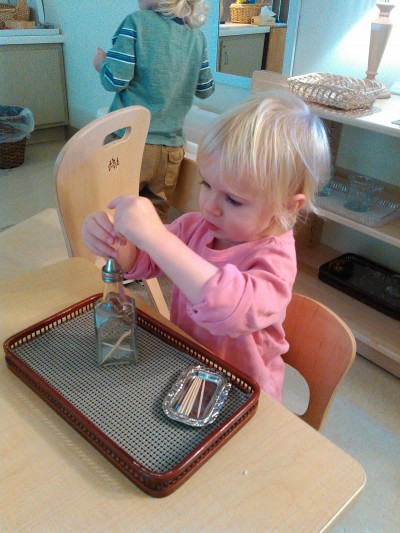 A toddler is seated at a small table, carefully guiding a toothpick through the tiny hole in the top of an oil & vinegar shaker. Beside him, a classmate carefully pours water into a vase before adding a few small stems of flowers. Nearby, a teacher and children use blunt slicers to prepare cucumbers for the morning snack. Scenes like these are hallmarks of the Montessori toddler classroom, and look quite different from many other early childhood settings. To the unaccustomed eye, the purpose of these activities, cobbled together from seemingly random household items, can be difficult to discern. But upon close inspection, one notices that the first child holds the toothpick with a grasp closely resembling the pencil grip he'll eventually master. His classmate is developing focus and concentration as the flowers engage her senses of sight, smell, touch, and aesthetic awareness. And those involved in the preparation of the healthy snack are now inclined to sample it themselves.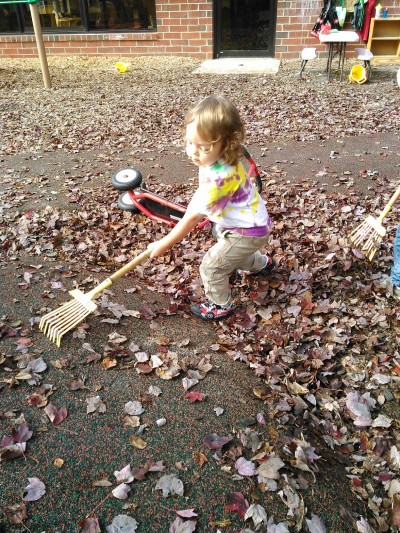
- Promote a sense of pride and ownership in the classroom environment.
- Enable children to interact with real-world objects, mastering the use of tongs, juicers, tweezers, rakes, basters, and other implements they'll encounter for the rest of their lives.
- Enhance physical coordination, promoting both large and small muscle development.
- Build independence and self-esteem by providing toddlers opportunities to care for themselves.
- Convey a sense of trust between caregivers and children, communicating that we see them as capable and worthy of using the real tools, kitchen devices, and other household items they long to explore but are often forbidden.
- Allow children the gratification of completing a defined task from start to finish.