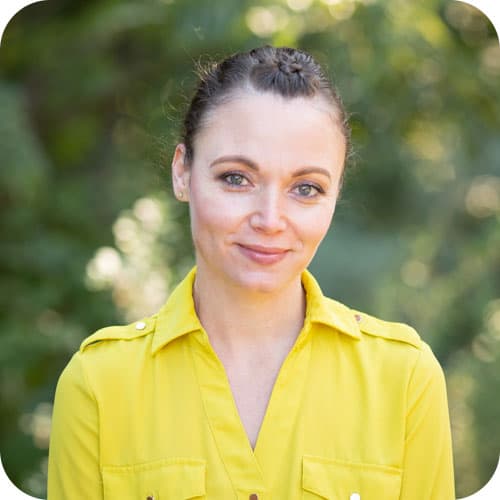
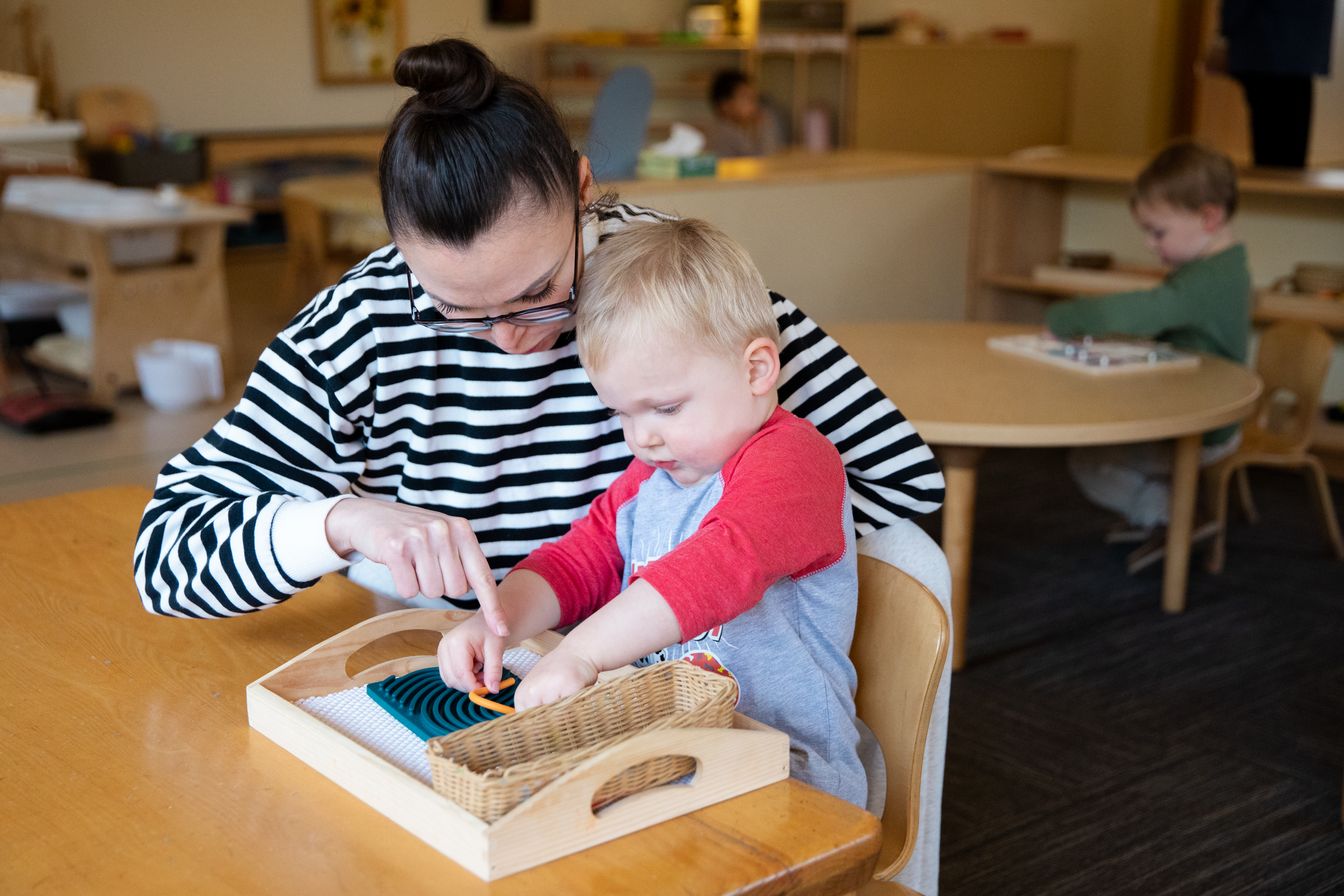
Anna Betina is our Toddler division coordinator and Half-Day Toddler lead teacher. She began teaching in 2009 and joined our School in 2017.
A native of Ukraine, Anna is fluent in Ukrainian, Russian, Bulgarian, and English. She holds a master’s degree in psychology and childhood psychology and a doctorate in pedagogical and age psychology from her native country of Ukraine. She also holds her Infant & Toddler (birth to age 3) Montessori teaching credential.
Anna and her husband have a daughter who is in fourth grade at GMS. Outside of the classroom, Anna loves live music and also a quiet nap.
GMS: Why did you choose to work at Greensboro Montessori School?
AB: I did my research based on Montessori theory and fell in love with the method here.
GMS: What excites you most about working in your division?
AB: It excites me to see children as capable human beings, and it gives me huge feedback, which inspires me as a teacher.
GMS: What aspect of the Montessori method inspires you the most?
AB: A toddler's sensitive periods and how to prepare the environment that facilitates those effortless windows of learning.
GMS: What do you enjoy learning from our students, and what do you enjoy sharing with them?
AB: How to be patient and see the child. I love sharing my positive attitude to problem solving.
GMS: What do you enjoy learning from your coworkers, and what are you excited to share with them?
AB: Learning how to listen. Recently, we started sharing articles and podcasts across our division on how to support children in a fast-changing world and how to support this in the classroom. It was very exciting and inspiring.
GMS: Tell us something about yourself that we wouldn’t learn from your résumé or CV?
AB: I used to be a ballerina, and during my teenage identity crisis, I switched to wrestling for 3 years.
GMS: Where did you grow up, and do you mind sharing one favorite memory from childhood?
AB: I grew up in Ukraine. My favorite memory is playing outside with my friends without adult supervision. Also, going to camps each summer without parents for six weeks.
GMS: Do you have any pets? If so, what are they and what are they named?
AB: I have a Black Pomeranian named Mia.
GMS: Of all the places you’ve traveled to, what is your favorite destination and why?
AB: Italy because there is a lot of history and nature to explore.
GMS: If you could travel anywhere else, where would it be and why?
AB: Japan because I’ve never been there and would really love to experience the culture.
GMS: What is something you don’t get to do often but it still feeds your soul?
AB: Visiting my family in Europe.
GMS: What is your favorite snack?
AB: My favorites are seaweed and dried fruits.
GMS: You’re going out with friends? Do you meet for coffee or cocktails? What is your favorite drink from those selections?
AB: I like to drink coffee or tea, or a virgin cocktail.
GMS: Other than Dr. Maria Montessori, who would you like to meet from history and why?
AB: J. Lacan because I would love to understand his theory firsthand.
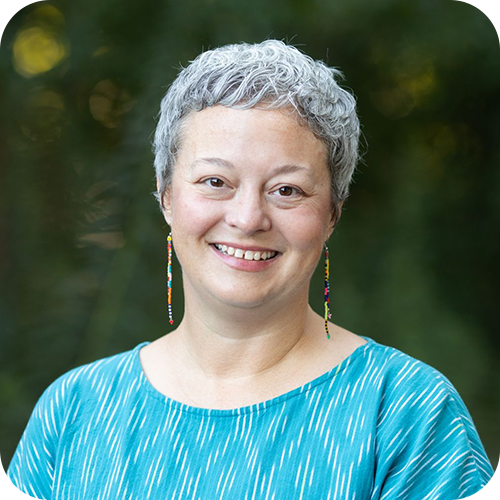
Katie Jones is a Lower Elementary teacher and has been teaching since 2001. She joined our team in 2014 and has always had a passion for both Montessori education and special education. She has a Bachelor of Science in psychology and a Master of Arts in special education from the University of North Carolina at Greensboro. She also holds her Montessori teaching credential in Elementary I (ages 6 to 9).
Katie grew up in Chapel Hill, North Carolina, and she and her husband, Matt, have a daughter, Willa, who is a member of the GMS class of '22 and currently a senior in the International Baccalaureate program at Page high school.
GMS: How did you first learn about Greensboro Montessori School?
KJ: We wanted a Montessori education for our daughter. She joined GMS when she was 4 years old. We absolutely fell in love with the school and the community. I decided to leave my teaching career with Guilford County Schools to come to work at GMS.
GMS: Why do you choose to work at our School?
KJ: The close knit community and the wonderful teachers.
GMS: What excites you most about working in your division?
KJ: The 6-to-9 age group is my favorite. I love the child’s sense of wonder and awe, their excitement, and getting to see those lightbulb moments ... I really enjoy teaching reading as well.
GMS: What aspect of the Montessori method inspires you the most?
KJ: The peace curriculum and focus on individuality, plus the hands on materials.
GMS: What do you enjoy learning from your coworkers, and what are you excited to share with them?
KJ: I enjoy observing various teaching styles and gathering their wisdom.
GMS: Tell us something about yourself that we wouldn’t learn from your résumé or CV?
KJ: I love True Crime. I collect nature. My home is my cozy nest and sanctuary, and my passion is to make it beautiful and homey.
GMS: Do you have any pets? If so, what are they and what are they named?
KJ: We have two dogs, Dusty Jones and Chloe Bell Jones and one cat, Oliver Wendell Jones.
GMS: What hobbies do you enjoy outside of work?
KJ: Gardening, hiking, nature, swimming, and reading.
GMS: Of all the places you’ve traveled to, what is your favorite destination and why?
KJ: Two weeks in Maui, Hawaii. It was my first trip with my husband. It had breathtaking scenery.
GMS: If you could travel anywhere else, where would it be and why?
KJ: Italy because of the food, beauty, culture, and art.
GMS: What is your favorite indulgence?
KJ: Affogato (vanilla ice cream, caramel, and warm espresso) and a massage.
GMS: What is something you don’t get to do often but it still feeds your soul?
KJ: A full day of antique shopping and lunch with my mama.
GMS: What are your favorite snacks?
KJ: Nachos.
GMS: Other than Dr. Maria Montessori, who would you like to meet from history and why?
KJ: Anne Frank. We need to learn from history.
Isabelle Bangham joined our School in 1996 as a Primary teacher. She has her Bachelor’s Degree in educational studies from the University of Nice, France and her Montessori teaching credential is in early childhood (ages 2 ½ to 6). Isabelle is originally from Nice and quickly found GMS when she moved to Greensboro.
Isabelle currently works in the Primary 4 classroom with her co-lead teacher, Jackie Shannon. Primary 3 teacher Carmen Romero is also a good friend of Isabelle and has been at GMS for over 30 years.
GMS: How did you first learn about Greensboro Montessori School?
IB: Through a neighbor after my family and I moved back from France to Greensboro, NC.
GMS: Why do you choose to work at our School?
IB: GMS is a very special school where teachers respect their students, and because I believe in Maria Montessori's principles. I have had my two daughters here and they have learned a lot in a safe and wonderful environment who taught them skills that they would not have learned elsewhere.
GMS: What excites you most about working in the Primary division?
IB: I love the fact that each day is a new day and that we can start all over again to help our students the best we can! I also love creating an environment where my students feel loved and appreciated, where they can enjoy learning and have fun!
GMS: What aspect of the Montessori method inspires you the most?
IB: "Following the child", also being respectful and trusting the child.
GMS: What do you enjoy learning from our students, and what do you enjoy sharing with them?
IB: I enjoy seeing their beautiful smiles, their love of learning, their curiosity, and their spirits. I enjoy learning from them their learning style, the way they see others and life, but above all, I love their enthusiasm for everything that they discover and explore every day! I enjoy sharing my gratitude for life, wisdom, kindness, embracing differences, the ability to accept people who are different, empathy, compassion, appreciation of beautiful things, love of traveling, and the French language.
GMS: Is there anyone in your family or close circle of friends that you'd like to tell us about? If so, who?
IB: Yes, my good friend Carmen Romero is a Primary teacher and works next door! I worked with her at the beginning of my career at GMS and we are very close. She was also my children's Primary teacher. Our oldest daughters are very good friends and now have children who are about the same age, so they do a lot of things together! It makes us very happy to know that they are doing life together as parents and can help each other! I have been part of GMS for almost 30 years (and counting), so I know a lot of staff and teachers here. I am blessed to be part of this wonderful community of teachers and students, and I feel good to be a part of this big family!
GMS: Tell us something about yourself that we wouldn’t learn from your résumé or CV?
IB: Nine years ago I became a grandmother of a sweet little baby girl, and five years ago, another angel came along, so I feel very blessed and my heart is very happy to be able to spend time with them and teach them everything that I know! When times are rough, they are always there to remind my husband and I that we have so much to look forward to and so much love to give every day! They are the apples of my eyes!
GMS: Where did you grow up, and do you mind sharing one favorite memory from childhood?
IB: I grew up in Nice on the French Riviera in the South of France. I have fond memories of the beach and different places where my brother and I went with our parents. One of my favorite childhood memories is going to Spain (Eastern part of Spain) with my family. We used to leave in the afternoon and my brother and I would sleep in the car. We would get there late at night, but everything was open and we loved going to eat at the "Bodegas"! We would stay in nice hotels and it was just great! Both of my parents have Spanish origins! My great grand-father was from the island of Mallorca.
GMS: What hobbies do you enjoy outside of work?
IB: I enjoy practicing yoga in class, swimming in the summer with my grand-daughters, going on walks, gardening and cooking when I have the time! I also love organizing parties! In the winter, I like to have Tea at the O'Henry in Greensboro!
GMS: What is your favorite indulgence?
IB: I love chocolate, crepes, french pastries. I love traveling! I also love flowers!
GMS: What is something you don’t get to do often but it still feeds your soul?
IB: Having a facial, or a massage, but the first one is definitely so relaxing and good for my soul!
GMS: Other than Dr. Maria Montessori, who would you like to meet from history and why?
IB: I have always loved and respected Maya Angelou as a poet, writer, actress, director, producer, and Professor and I had the pleasure to see her at one of our AMS conferences in NYC years ago! I love her words of wisdom and quotes.
GMS: Is there anything else you would like to share with us?
IB: I miss my family in France and wish they were closer! I wish it was not so far away! I also enjoy living here in the U.S.A and wish I could have both worlds! I have many blessings in my life including my husband of almost 43 years, and my daughters, son-in-laws, and my lovely grand-daughters!
Cindy Webb is a familiar face at GMS and is about to become even more hands-on in the world of Montessori education. She has been a room parent for eight years and is now officially stepping into her new role as lead coordinator of the Greensboro Montessori School Community Association (GMSCA).
GMSCA has dialed back in the past few years due to the effects of the COVID-19 Pandemic, but Cindy’s mission is to make the organization even stronger than it was before. At a school where meaningful relationships and involvement are integral, her goal is to create a deeper connection between children, parents, and teachers. She has a long history with Montessori and is excited to bring her expertise to the table.
“My husband, Daniel, and I began our search for a school when our son Isaac was 2 years old. Some of our friends always spoke so highly of their children’s Montessori learning experiences, which led me to inquire at GMS. Once we toured the Toddler and Primary classrooms, I knew this was the place where I wanted him to grow. I saw how Montessori’s multisensory approach to learning could build a deeper level of knowledge and awareness than is offered at most schools. The beautiful outdoors spaces (such as the gardens, playgrounds, and woods) really resonated with our family as important learning spaces as well.
Our son Isaac entered Primary in 2016 when he was three years old. He has completed three divisions here and is now a seventh grader in Junior High. Observing typical days in Primary and Lower Elementary allowed me to fully appreciate the expertise of the teachers not only in curriculum, but also in childhood development and management skills. Lower Elementary is where I saw the spark develop for our son to follow his intellectual interests. While those interests have changed over the years, immersing himself in learning about a current focus remains strong. It’s a trait that I envision serving him well throughout his life.”
GMS dedicates children to a life of learning and connecting with the world around them. The Webb family felt these values outside of the classroom and easily connected with the GMS community.
“Conversing with fellow parents about learning experiences across the different divisions, particularly about what to expect in the upcoming years, has been meaningful for us as we have reflected back for others and also looked ahead for ourselves. We also have appreciated the many community events that GMS coordinates for families to come together on and off campus like Curriculum Night, the Fall Festival, and Spirit Night at the Grasshoppers game. Visiting with familiar faces and touching base with new families is the spirit of the GMS community.
One common aspect that I see among the GMS faculty and staff is how dedicated they are to each family and to the role they have in nurturing relationships here. There are over 250 students and even more family members that faculty and staff encounter on campus, from the front desk, to carline, to a large event such as the Fall Festival. They somehow recall every name and make personal connections with us all. That level of engagement with families is impressive. Teachers and staff at GMS love their jobs and know the value of their work. Having a teacher that truly knows your child — how they think, how they learn, and how they interact — is quite special.”
Throughout her time at GMS, she looks back on helping teachers as a room parent fondly. Another mission of hers in her new leadership position is to find ways to show more appreciation towards teachers.
“Time spent with teachers in each division helped me to know them as individuals of shared values and concerns and also to appreciate their influence on students. The work that I have done to support our teachers has allowed them to focus more of their time on the critical work they perform in the classroom and after hours.”
In the past, she created the idea of teacher-affirmation boxes that could be filled with notes from parents and students. Cindy states that having these simple gratifications not only represent GMS values, but also allows those in the home and at school to nurture each other.
She only wants to continue and improve this work in GMSCA.
“Working toward creating meaningful connections and increasing involvement among GMS families is a large priority for this year. One idea I am most excited about is building an active parent education community. We all know how challenging parenting can be, especially when we care so much about understanding what is best for our child’s future. I would like to bring together parents that want to learn mindful approaches for home that support the foundations our children gain here at GMS. A few ideas I am working to develop are a parenting book club or discussion group and also follow-up discussions to the virtual ISACS Parenting Series that GMS will offer again this year.”
Lastly, she has some hopes and dreams as a leadership coordinator. Just like every parent here at GMS, she sees a future for her child and for the village that helps him grow.
“The GMSCA hopes to bring together families in a variety of gatherings on and off campus this year. Many of us build connections with fellow parents centered around the friendships of our children. My hope is for the GMSCA to build relationships across GMS that extend further into our shared interests. One way we intend to do this is through establishing several committees of engaged parents to facilitate connections and support across a variety of school activities and initiatives. The GMSCA has the potential to create so many meaningful connections with faculty, staff, and families that could enhance school experiences and also further enrich our lives. I want all parents to participate in a sense of belonging and purpose at GMS. We hope that you all will join us in the opportunities to come.”
Cindy and her husband Daniel, along with their son, Isaac, are beloved members of GMS and the Montessori community as a whole. Her work as a room parent has already shown her commitment to her community and how she embraces every aspect of it. Keep an eye out for any communications from Cindy in the near future as she embarks on her hopes and dreams for the GMSCA.
Valid and reliable scientific research and brain development theory should be the driving force behind any school system.
Sadly, in our country, that is too often not the reality. Too many of our nation’s schools are based on an industrial-era, conveyor-belt, “information-in, information-out” style. Missing in this antiquated approach is the child as an agent and the child as an engaged, responsible, and confident citizen and leader.
We are incredibly fortunate that this is not missing at Greensboro Montessori School. We are fortunate that our pedagogy, our methodology, and our very way of learning, thinking, and being are based in sound scientific theory and research. Dr. Maria Montessori saw to that.
Maria Montessori was a scientist. She was a physician, educator, feminist, barrier-breaker, and innovator who utilized scientific observation and experience working with young children to design learning materials and a classroom environment which foster a child’s natural desire to learn. Dr. Montessori opened her first school (Casa dei Bambini) in 1907, and today there are close to 4,000 certified Montessori schools in the United States and about 7,000 worldwide. She developed a school movement that is perfectly in-line with what modern science and today’s neuroscience research confirm our children need.
Even though the field of modern neuroscience and brain research did not exist during her time, her theories and methodologies have withstood the test of time, and today neuroscience and brain research fully support the Montessori methodology. Our recent professional development visit with Dr. Steven Hughes brought together the worlds of Montessori schooling, brain development, and research. Dr. Hughes is a board-certified pediatric neuropsychologist and past president of The American Academy of Pediatric Neuropsychology. His research interests are on what promotes the growth of executive functions, social-emotional skills, and moral reasoning. Additionally, he and his wife have had a longstanding relationship with Montessori: she is an Association Montessori Internationale (AMI) trainer throughout Europe, and Steve is the founding chair of the Association Montessori International Global Research Committee. Adding Steve’s voice to our ongoing dialogue about how we can provide the best Montessori experience possible was exceptionally valuable to us. Over two full days, we had affirmations of what we do, challenging conversations, new inspirations, and reinvigorated aspirations.
Steve framed many of his remarks around what research has shown students really need for success in life. Yes, good grades on tests are helpful as they create access to future opportunities, but good grades on tests alone are not the most important thing. Research shows they are not correlated with success in life, and they are not what companies like Google, IBM, and Ernst & Young look for in new hires. These companies want individuals who can analytically solve difficult problems, who can work collaboratively within a group, and who can leverage complexity. They want people who can look around, figure out what needs to be done, and do it. They want original thinking ... conventional schooling is not aimed at helping students develop original thoughts. Montessori schools, on the other hand, are absolutely set up to elicit and generate original thinking.
What students do need to succeed are the underlying neuro-structures of their brain to be fully developed and finely tuned. Dr. Hughes talked to us about how this all happens in the neocortex, the skin of the brain: the neocortex has the area of a linen napkin unfolded and is just a few millimeters thick. In there are at least 6 layers of interconnecting neurons that are extraordinarily complex. And while you may think our neocortex is for “thinking,” really it’s to build a sensory-motor map of the world and to manage sensory inputs, sequences, and patterns. For example, when we sit on a chair or drive a car, we don’t actively “think” about it, as we have a sensory-motor map of those processes and have built within our neocortex perceived expectations of how something like a chair or car works. When we learn how to respond to existing patterns and how to manage anomalies - that’s how we get good at things. It takes practice. As Jeff Hawkins writes: “Patterns are the fundamental currency of intelligence.”

This model of a cortical homunculus illustrates how our brain perceives our hands as the body's primary receptor of sensory motor input.
The way we build those sensory motor sequences which are stored in the neocortex and are the foundations of all that we do when we’re reflexively thinking (or non-thinking) is by doing things. This is the neuroscientific explanation and defense of experiential education. Dr. Montessori knew this, and it makes sense that she is known by many to be the “mother of experiential education.” As Dr. Hughes puts it, “We are human doings, not human beings.” This picture is of a cortical homunculus in The Natural History Museum of London. In layman's terms, it is a model of how our brain perceives our own bodies -- the hands are the mechanisms for receiving sensory input so they are the single most valuable body part to the neocortex. We survive in the world by manipulating the environments around us - it is our skillful interaction with the world that defines us and allows us to be successful. To find this success, we have to build the neocortex. And to build the neocortex, we have to practice doing things; and we have to develop the mechanics and apparatus so the brain knows how to do new things. Practice is how our brains build themselves. That is what Montessori does. All our lessons in motor skills, self regulation, language, math, and sensorial input are presented in individual, sequential ways which build upon previous knowledge and previous sensory motor patterns. This is how we develop the brain, and how our students find success in both school, and more importantly, throughout their lives.
Dr. Hughes reminded us that Montessori education is based on children having “effortful, motivated, repeated, trial-and-error, experimental interactions with the environment.” That’s what happens in our school every day. It’s what empowers our students to find tremendous success in their school settings at Greensboro Montessori School, in high school, and college. While the focus of Dr. Hughes’ talk was not how the Montessori methodology promotes traditional academic success success, it is part of the story because helping children optimally develop their brains helps succeed in life, which includes school.
Dr. Hughes told us, “when we are talking about a well-constructed constructor, we’re also really talking about IQ.” One pretty good definition of intelligence quotient (IQ) is the ability to construct new sensory-motor couplings. Children who are able to fully develop their neocortex have well-developed sensory-motor maps and are able to best make sense of anomalies and new patterns, and thus solve difficult problems.
We see these benefits throughout Montessori, and they are documented in Angeline Lillard’s classic Montessori study which was published in 2006 in the journal Science. Through measuring IQ with the Woodcock-Johnson Tests of Cognitive Abilities and studying randomized groups of students in and out of a Montessori program (with an experimental control group), Lillard found Montessori students performed better than non-Montessori peers by nearly a half standard deviation. The best standard deviation improvement from an educational intervention is about a quarter standard deviation; the change of nearly half a standard deviation is monumental.
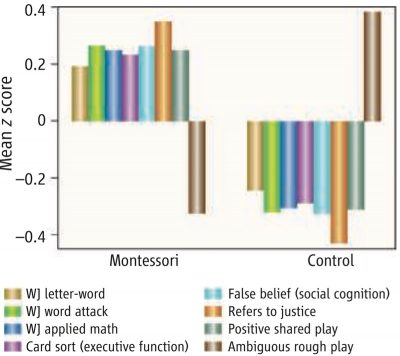
Lillard's 2006 study found that Montessori students outperformed non-Montessori peers by nearly a half standard deviation in several areas.
It’s also important to remember that scoring well on tests and doing well in school is not necessarily what predicts success in life. We’re not saying school isn’t important, but we are saying success in school shouldn’t be seen as the end result. School success is important because it gives access to future experiences and opportunities. More important is that when your child goes to a school like Greensboro Montessori School, they learn the ability to look around, figure out what needs to be done, and do it -- this skill allows them to not only be successful at school, but most significantly, it allows them to be successful in life.
In addition to his fundamental point that experiential education and the Montessori methodology allow students to effectively develop their neocortex and to find success, there were several other key takeaways from our two days with Dr. Hughes. In the various discussions we had, many of the ideas applied to what we can do at home as parents and in the classrooms as educators.
Let the constructor construct.
By taking a neuroscience look at learning, we know that when our youngest children are engaged by doing physical things in their learning, their neocortex in their brains are actively being constructed -- this construction is hard work and requires uninterrupted, child-driven, large blocks of time. Let the constructor construct.
Do not overpraise the child.
Too many parents in our culture praise and overpraise children - sometimes for the simplest of accomplishments. Dr. Hughes reminded us that overpraising children can have negative effects. Research has shown that evaluative feedback (like grades and praise) can stop growth. Dr. Montessori reminds us, “Praise, help, or even a look, may be enough to interrupt him, or destroy the activity. It seems a strange thing to say, but this can happen even if the child merely becomes aware of being watched.” Dr. Steven Hughes jokes with us, “Parents need to really take a good, hard look at your bizzare, irrational, and unnatural desire to praise your children for breathing. Not only does this praise disrupt the child’s concentration, but this evaluative feedback does no good for the developing brain.” While coaching with specific feedback on how to do a task can be valuable, blind praise is not. Again, let the constructor construct.
Never do for the child what they can do for themselves.
Children can often be more capable than we let them be. In Montessori, we are careful to allow the child to do their own work, rather than us do it for them, be it complex math problems or putting on a jacket. We challenge parents to do the same. We do so, because we know from Dr. Hughes that doing and practicing their work allows them to appropriately develop their brains. Yes, it may take more time and patience from us as parents, but let the children do their work -- it’s one of the ways they build their brains.
Montessori does executive functioning very well.
Executive functioning is what we do with our IQ below the level of consciousness – how we organize, make sense of, and make discernments in order to execute and make decisions. From the neuroscience perspective, this is called cognitive flexibility and is an important part of executive functioning: when Plan A doesn’t happen, we have to have the flexibility and adaptability to create Plan B. Executive functioning is developed when the neocortex is allowed to develop those sensorial-motor maps through repeated practice and doing.
Concentration is fundamental to Montessori.
Classrooms at Greensboro Montessori School are based on giving children time to concentrate. Too many other school systems shuffle children from one idea or class to another every 34 minutes. From the neuroscience perspective, Dr. Hughes told us that concentrating is engaging the frontoparietal network in effortful cognitive tasks, where rules or information learn to be utilized and to guide behavior. Dr. Montessori knew that “Concentration is the key that opens up the child to the latent treasures within him.” Once again, her methods developed over one hundred years ago are today confirmed by modern neuroscience research. This concentration is how we develop capacity and capabilities to link together all our future skills and ultimately succeed in a complex world. It’s the foundation for us to learn how to look around, figure out what needs to be done, and do it.
Never interrupt the concentrated child.
Children innately want to explore, to touch, and to engage in certain types of work or projects. At various parts of their developmental journey, they are drawn to different things. And it is nature’s design that they want to do some work, or age-appropriate activities, again and again. Somehow, they know they need to practice them. And through modern neuroscience, we now know very well that this practice of building sensory-motor maps in the brain is one of the ways the neocortex develops within the brain. We know this is the foundational building block for future thinking. And through research and brain scans, we know that when the child is actively working and concentrating, they are literally building their brains.
When this is happening, this brain building, there is nothing we can or should do. We need to step back, let the child direct, and let the child be inspired. Never interrupt the concentrated child; it is then when they are constructing. In a Montessori classroom, we build time and systems to allow children to find real concentration and to focus on big work. While they aren’t able to work on one project or subject the entire day as there are other lessons and other parameters for the day, we do pride ourselves in having blocked times (sometimes as long as three hours), where the children can focus on their work and consequently develop their brains. As parents, we should work to not interrupt a focused and concentrated child; while a quick picture, a redirection, or new idea from us may be so tempting… try to resist that urge, knowing that concentrated work is very important, that our children are literally developing their brains.
For two full days, Dr. Steven Hughes toured out school, and engaged with our faculty, our students, our parents, and our administration. When he stepped away he wrote to us: “I can tell you are heading into one of those wonderful chapters in an organization with the right people are on the bus, and the bus is headed in the right direction. One can’t always force those conditions but when they are present amazing things can happen. I’ll look forward to hearing about the amazing things happening at Greensboro Montessori School in the future!’
There is something incredible happening at Greensboro Montessori School!
That “incredible” lives within the people and the work our students do every day; that “incredible” permeates our culture and the program. When any of us answer the question, “Why Greensboro Montessori School?”, this “incredible” is most likely part of our answer. We intuitively and deeply know there is extreme value in a Greensboro Montessori education. We know that the School both nurtures and pushes our children; loves and empowers them. We know that our children are learning to think critically and originally, to look beyond polarizing black and white perspectives, to lean into complex and difficult ideas, and to work effectively, eagerly, and ethically within a team. We know that there are some of the best teachers in the entire state of North Carolina caring for our children every single day. We feel this.
While we all know these things to be true, our team has been working on providing families with data points that answer this question (Why Greensboro Montessori School?) in a more analytical fashion. In our reenrollment packets, you will see some of the quantitative data we have been gathering. You’ll see data that tells you the average ACT score in North Carolina is 19 and our college-aged alumni’s average is 30. Or that our students’ English composite scores on our standardized tests is in the 92nd percentile nationally. Or that 88% of our students feel like they were very well prepared high school.
In addition to quantitative data like this, there is also important qualitative data that answers this same question. Some of the best qualitative data comes from our alumni students and families. At our recent Grow With Us event for each of our students and families who will transition into a new division in the fall, we invited two of our alumni parents, Nancy King Quaintance and Dennis Quaintance, to reflect on why they kept their two college-aged children at Greensboro Montessori from toddler through to graduation. Below are a few excerpts from their remarks:
[dt_sc_pullquote type="pullquote1" align="center" icon="yes" textcolor="#81d742"]The thing that kept bringing us back and causing us to know that Greensboro Montessori School was the place we wanted to be can be summed up in one phrase - a loving community. We felt like our children were understood and appreciated for who they were.[/dt_sc_pullquote]
[dt_sc_pullquote type="pullquote1" align="center" icon="yes" textcolor="#81d742"]Another thing that brought us back is that we believe that for any organization, to really function to its potential, it has to have a compass and a sense of north. And every time we were in a [parent] conference whether it was with Doug or Jonathan in middle school or with the Primary teachers, without it being scripted, [the teachers] would say 'this is happening because its part of the idea of children being eager learners and discovering their potential to become responsible global citizens.' It makes me want to cry because imagine if we could do that as a whole global society.[/dt_sc_pullquote]
Those qualitative data points spoken by alumni parents who were at our School for 12 years can help inspire those of us who have had children at the School for only one or two years. Perhaps even more inspiring, though, is listening to their college sophomores reflect on their journey at Greensboro Montessori School. Please click on the link below to hear why they loved their time with us:
Finally, one more type of answer to the question, "Why Greensboro Montessori School?", comes from scholarly research. Dr. Maria Montessori herself was a scientist. Her methods and practices were all based on known science about human development and student learning. Educational scholars and practitioners are also always reflecting on and researching the Montessori methodology.
A 2012- 2016 Longitudinal study involving 43 Montessori Programs was recently published by the Riley Institute at Furman University. One of their conclusions was “a higher percentage of students in Montessori programs met or exceeded state performance benchmarks in language arts, math, science, and social studies, and showed faster growth in language arts over the course of the study.”
And if you need one more answer, it’s because it’s what we ultimately want for our children. We want them to be successful, well-adjusted, confident, competent, and creative people. And we know that Greensboro Montessori School can help them become just that.
Really, what more could we ask for?
"The willingness to show up changes us. It makes us a little braver each time." - Brené Brown
I think Brené Brown and Maria Montessori would be fast friends, had they lived during the same time. They both believe deeply in showing up as who we are … and in following that authentic self. Montessori calls it following the child; Brown calls it being authentic and vulnerable in order to find wholehearted living. It’s important to say that the concept of “vulnerability” has evolved into a positive and beneficial behavior and characteristic in both Brown’s and my research.
Montessori wrote that “the child is capable of developing and giving us tangible proof of the possibility of a better humanity. We have seen children totally change as they acquire a love for things and ideas and as their sense of order, discipline, and self-control develops within them.... The child is both a hope and a promise for all humankind.” A hope and promise for humankind starts at the center of the child’s ability and gift to show up as who they are. If this concept interests you, I thought I’d walk you down a path of Brown’s research, and why I think it ultimately connects to our work at GMS.
Brown began her research journey in the field of social work with her basic belief about the necessity of human connection. “Connection is why we’re here; it is what gives purpose and meaning to our lives” (Brown, 2012a, p. 253). Her dissertation explored assessing relevance in professional helping (e.g., pastoral care, psychologists, educators, or organizational leaders). Over six years, she interviewed 1,280 professionals to develop her theory of accompaniment.
Through asking her participants about human connection, she ended up developing the related ideas of shame and shame resilience. Asked about human connection, participants invariably ended up talking about instances of heartbreak, betrayal, and shame, which Brown defined and coded as the fear of not being worthy of real connection. That emerging pattern led her to return to her data to investigate why and how some were resilient to this shame, heartbreak, and betrayal. She eventually developed a model of shame and shame resiliency, which revolved around empathy, courage, compassion, and connection. The patterns in her data pointed to wholeheartedness, which Brown developed into what she called wholehearted living. And from her study of wholehearted living, Brown then focused her research attention on the power of vulnerability. Vulnerability and having the courage to show up authentically and humbly as who we are connects to how we ask our students at GMS to show up. Brown (2012a) wrote, “Vulnerability is the core, the heart, the center, of meaningful human experiences” (p. 12). Vulnerability (being open, authentic, and humble) directly connects to a person’s ability to honestly know their self and their limitations.
Here is where we begin to connect more to the work we do at Greensboro Montessori School. We believe, just as Maria Montessori, that we are always striving for meaningful human experiences and lessons. To achieve this, we need to empower our students to think independently, critically, and openly. And that takes courage.
To be comfortable with their personal vulnerability, Brown writes that people must first have a strong sense of love and belonging. We work to instill that belonging everyday in all our classes. That sense of worthiness is a foundational path for students to find greatness. Conversely, when people cannot be real and honest, i.e. vulnerable, they block great ideas and innovation. Brown (2012a) identifies a lack of vulnerability as the “most significant barrier to creativity and innovation” (p. 187). This lack of vulnerability fosters a fear of change and close-mindedness. If we cannot empower our students to take safe risks and to see the value of struggle and failure, then we may be stinting their ultimate growth.
It takes courage and bravery for students to have new ideas and try new things. Entrepreneurship, growth, and new ideas cannot thrive in an environment that does not welcome openness and authenticity. One participant in an interview with Brown (2012a) said, “When you shut down vulnerability, you shut down opportunity. By definition, entrepreneurship is vulnerable. It’s all about the ability to handle and manage uncertainty” (p. 208). Entrepreneurship thinking and habits of mind is something we pride ourselves on at GMS.
And as for how we create a culture that welcomes these ideas of vulnerability, true courage, and entrepreneurial thinking, school research is crystal clear that we need adults in schools (leaders and teachers) who are willing to display and model this open sense of courage in a quest for better understanding and learning. The adults must first have the courage and wisdom to intentionally be vulnerable. As an adult learning community of about 60 employees, we work everyday to be open to ideas, as we mindfully and intentionally follow the child. I also invite each of our parents to intentionally join us on that journey as we partner to help empower our young people to be confident and inspired to display the sort of courage that Brené Brown writes about.
I’ll leave you with a final thought from Brown. While the quote is specifically about leaders, I think applies all the same to us as parents, as teachers, and as human beings:
“Across the private and public sector, in schools and in our communities, we are hungry for authentic leadership – we want to show up, we want to learn, and we want to inspire and be inspired… When leaders choose self-protection over transparency, and when self-worth is attached to what we produce, learning and work becomes dehumanized… Re-humanizing work and education requires courageous leadership. It requires leaders who are willing to take risks, embrace vulnerabilities, and show up as imperfect, real people. (Brown, 2012a, p. 5)
Have a great and courageous weekend.
- Kevin
Works Cited
Brown, B. (2002). Accompanar: A grounded theory of developing, maintaining, and assessing relevance in professional helping (Unpublished doctoral dissertation). University of Texas, Austin.
Brown, B. (2010a). The gifts of imperfection: Let go of who you think you’re supposed to be and embrace who you are. Center City, MN: Hazelden.
Brown, B. (2012a). Daring greatly. New York: Gotham Books.
Brown, B. (2012b). Vulnerability and inspired leadership. Bill & Melinda Gates Foundation Leadership Series.
Montessori, M. (Published 1992). Education and Peace. The Clio Montessori Series.
Click here to check out a whole host of books and audio published by Brené Brown
What do the oldest fabric in the world and a vintage typewriter have in common with my dentist? And what do they have to do with art? Well, I encountered each of them in the course of one week, and the intersection of these seemingly disparate things gave me an “a-ha” moment about the symbiotic relationship between creating with technology and hands-on art making in our School’s art studio.
As a mixed-media artist, I am naturally drawn to tactile, malleable, hands-on materials and adore using these materials in my lessons. If you walk into Greensboro Montessori School’s art studio, you will see a variety of rich textures, fibers, paints, clay, found objects and nature. You will also find a technology wall where one of the School’s 3D printers, a computers and iPads live. These two worlds co-exist harmoniously in our art studio and with each new day I am learning and teaching how technology and art are interwoven and applied in the world beyond the studio.
For instance, many Greensboro Montessori School faculty recently participated in an excellent coding workshop from Code.org. During this workshop I learned how coding is fun and creative and identified a great way to apply this technology in my classroom. Once armed with coding knowledge, students can practice their skills by writing an algorithm resulting in a specific design being drawn on their computer. They can bring this code to their art lesson and exchange it with another student. From there, students run each other’s algorithm to see if it produces what the creator originally intended.
Another project where technology and art intersect is stop motion animation. Students use a stop motion app on our classroom iPads to tell stories, but they also use physical objects make stop-motion animation the good old-fashioned way (by moving an object in small increments, taking photos of the object after each movement, and viewing multiple photos per second in a continuous sequence to create the illusion of motion). One of the most famous stop-motion animation films is the 1964 television special, Rudolph the Red-Nosed Reindeer. In our classroom, students manipulate KEVA planks, not wireframe figurines, to make their movies. The excitement has been great, and upper elementary students often rush back to class to ask Cathy Moses to come see their work!
Middle school students have been very helpful in teaching upper elementary students about the School’s 3D printer and 3D drawing program, SketchUp, which brings me back to my “a-ha” moment about the connection between art and technology. Within the course of one week at school I led a felting project demonstrating how to create with the oldest fabric in the world and guided lower elementary students in a freedom of speech exercise where they used a vintage typewriter to create art with their own words. I was reminded how each of these discoveries represented a technological shift at the time of their invention. At the end of the week, I went to the dentist and experienced a modern technology and art revolution in the making.
As crazy as it sounds, and as personal a story it is, my time at the dentist was real-world affirmation of the integration of art and technology. I was scheduled to get a crown and had anticipated my visit being the first of two required to complete the procedure, but then I was introduced to CAD/CAM (computer-aided design and computer-aided manufacturing) dentistry. While I was in the office, my dentist used technology to capture a 3D rendering of my tooth (CAD) and reproduce it onsite with a grinding and milling machine (CAM). While the grinding process used in my dentist’s office is different from the fabrication method used in 3D printing, the use of technology to produce sculpture in both cases highlights the inspirational interplay between technology and art. (And to top it all off, my ceramic crown was fired and glazed onsite, just like our students’ pottery is fired and glazed in our kiln!)
As we continue to create with our hands in collaborative and productive ways in Greensboro Montessori School's art studio, we will continue to grow the use of technology as well, because technology helps strengthen the development of our students 21st century skills and introduces them to career opportunities where art and technology co-exist.
This summer I've been introduced to Montessori Market, a summer camp Greensboro Montessori has offered for the last 17 years. Through a unique blend of environmental education and hands-on learning, campers participate in a week-long business preparing consumer goods for sale to the general public at the conclusion of camp. Just as our 2016 graduating class impressed me, Montessori Market has revealed yet another School tradition which is so much more than meets the eye.
Montessori Market is an all-hands-on-deck camp featuring contributions from the entire school community. Whatever produce we can't harvest from our own permaculture gardens, we source from local farmers. Both faculty and students work together to gather ingredients before camp even begins. This year, Nancy Hofer, Mary Jacobson, Kristy Ford and Andi Bogan chaperoned our Lower Elementary Al Fresco summer camp students to a local blueberry farm where they hand picked blueberries for jam. We also needed peaches which led me to think about The Produce Box, a service which delivers fresh produce from North Carolina farmers to my doorstep each week. After one quick trip to Raleigh and the overwhelming generosity of The Produce Box, we had boxes of peaches, certified organic zucchini, green bell peppers, corn, jalapeños and tomatoes.
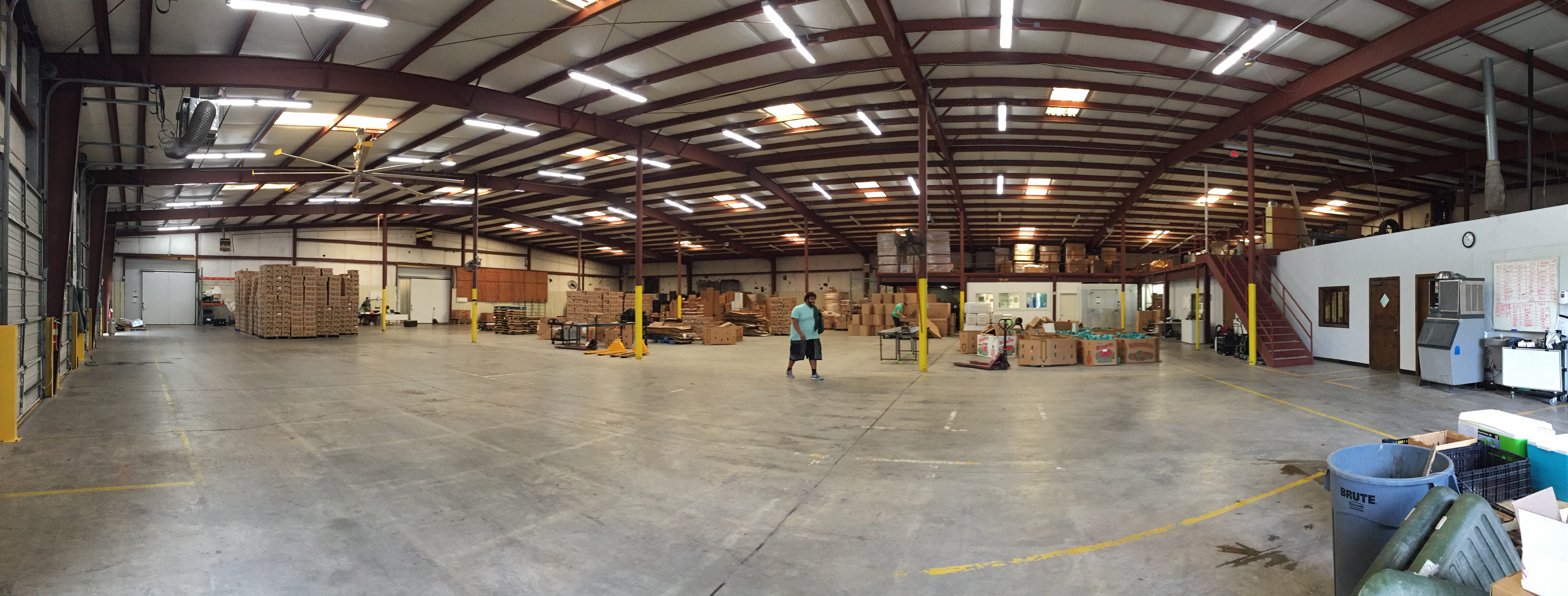
A panoramic view of The Produce Box's warehouse in Raleigh.
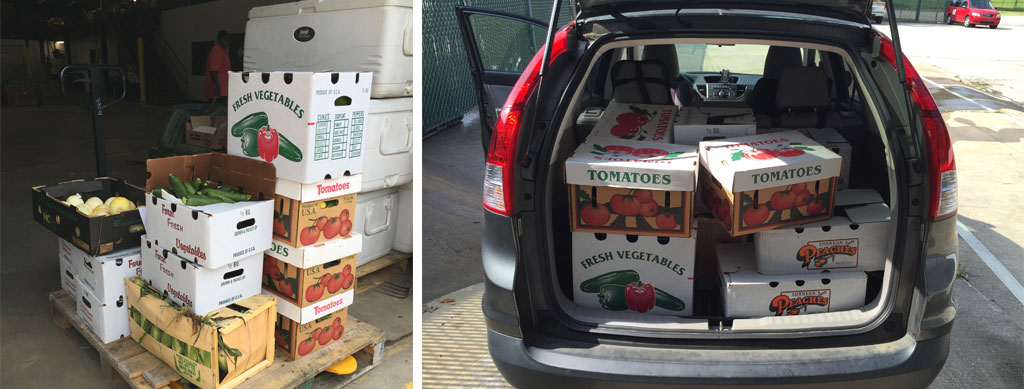
A pallet of produce generously donated by The Produce Box.
The students began camp with a full refrigerator of fresh, North Carolina-grown produce and three sprawling gardens from which to pick fresh basil for pesto and lavender for sachets. They have also made a wide variety of handmade crafts to accompany their foodstuffs.
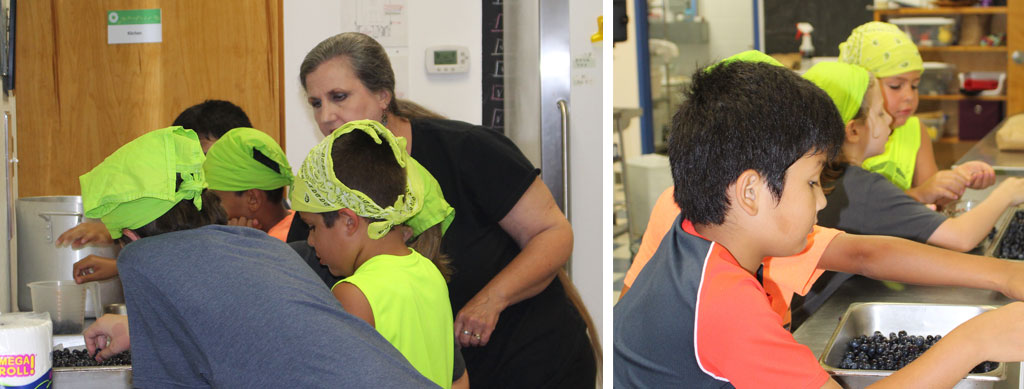
Mary Jacobson, a Lower Elementary faculty member, oversees food prep for blueberry jam.
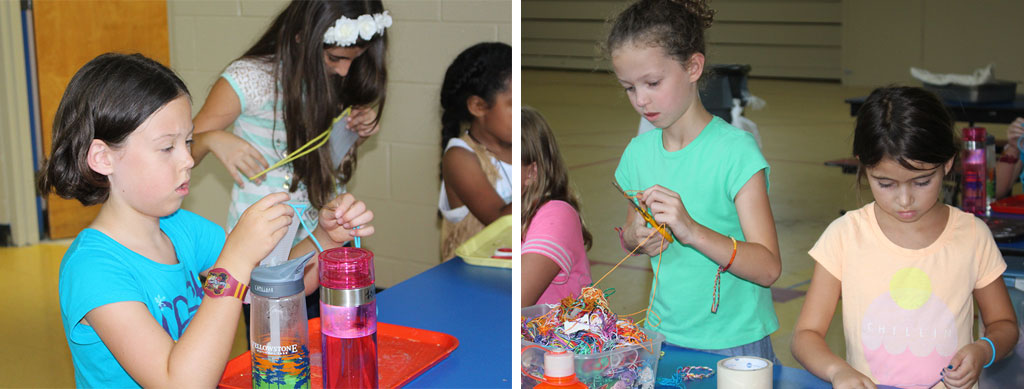
Campers prepare a variety of handmade crafts while taking a break form the kitchen.
As the students approach the end of the week, the most beautiful and compelling aspect of camp comes alive. With finished goods ready for sale, you have to wonder, "for whom and to whom will they sell their goods, and where?" I've since learned that Montessori Market has always worked for the benefit of children in need. Campers wake up bright and early to sell their products at the Greensboro Farmers Curb Market on the Saturday immediately following camp, and all proceeds are donated to a charity focused on kids. Hence, it's time to introduce BackPack Beginnings.
Founded six years ago by Parker White, a new mother at the time, BackPack Beginnings' mission is to deliver child-centric services to feed, comfort, and clothe children in need in Guilford County. By ensuring food and basic necessities are given directly to children in need, BackPack Beginnings makes a positive and lasting impact on their health and well-being. As a 100% volunteer organization, BackPack Beginnings serves over 6,000 children experiencing hunger and trauma in our community annually. Recently, Parker has been named one of four finalists for The NASCAR Foundation’s Sixth Annual Betty Jane France Humanitarian Award presented by Nationwide. This award honors incredible volunteers from across the country who have made a profound impact on children’s lives in their community. (You can vote for Parker daily from now until September 26; if she wins, The NASCAR Foundation will make a $100,000 donation to BackBack Beginnings.)
Our Montessori Market campers have been learning, cooking, and collaborating on behalf of BackPack Beginnings all week. This Saturday, July 30, they will be at the Curb Market proudly displaying their finished goods, and a donation to BackPack Beginnings will allow market-goers to shop from their products. In addition to the pesto and sachets, shoppers may also select from blueberry jam, peach jam, salsa, zucchini bread, and a number of homespun crafts.
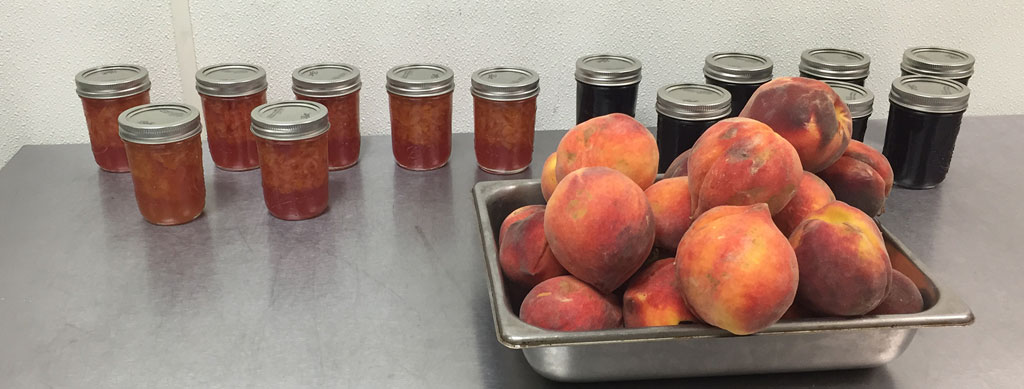
Peach and blueberry jams—lovingly made by students participating in Montessori Market—ready for display at the Greensboro Farmers Curb Market.
100% of the donations received on Saturday will assist the BackPack Beginnings' Food BackPack Program which helps fight childhood hunger in our community by filling the weekend food gap for children in need. By the numbers, this program sends 1,600 children from 26 schools with fresh food each weekend totaling 6,400 food bags per month. This effort is in addition to their Comfort BackPack, Food Pantry and Clothing Pantry programs. While our hope is that we receive enough donations on Saturday to empty our booth, any remaining products can be directly donated to BackPack Beginnings for direct inclusion in Food BackPacks or the Food Pantry.
So this is the story of how a summer camp evolves into so much more than a summer camp. How the Montessori philosophy challenges us, as adults, to push our kids to do more than text, snapchat and Netflix during summer break. How engaged faculty and community organizations prepare children for a lifetime of success by providing real-world experiences in running a business, manufacturing, time management, and philanthropy. And how children come together to help others less fortunate than themselves. And how Montessori Market is more than meets the eye.
My first day at Greensboro Montessori School was Tuesday, May 31, which was also the day of our Council of Elders interviews with our graduating middle school students. The week that followed was a crash course in the rich experiences exclusive to our students contrasted with the universality of adolescence…and most notably, the extraordinary academic and social accomplishments of students who have learned under the Montessori method of child-led education.
As I walked to Susana D’Ruiz’s Spanish classroom for my Council of Elders interviews, I quickly noticed how comfortable I felt in our middle school hallways. Down the main corridor, one side was lined with lockers, a familiar scene from any middle school in the country. And as I met with the interviewing graduates, I was immediately transported to middle school years when each moment swung along a pendulum between my own teenage angst and hubris.
But this group displayed a wealth of life experiences I never knew at 14:
- They had run their own businesses during Greensboro Montessori School’s holiday marketplace, not once, but three separate times in each of their years in middle school. This repetitive format allowed them to learn and improve their business acumen from one year to the next.
- They had traveled extensively studying U.S. government in Washington D.C.; visiting Biosphere 2 in Oracle Arizona; participating in the United Nation’s Global Citizen Action Project in New York City; and living with host families from The Summit School in Costa Rica.
- They had cared for a baby (albeit, a mechanical one) for a weekend, with dashed hopes of sleep as they tried to determine whether their baby needed to be changed, burped, fed or rocked. Any many had to pay their parents to babysit in order to maintain extracurricular commitments in sports and music.
- They had completed an introspective “Who Am I” project which had unlocked a fresh sense of confidence and creativity as they prepared for the leap to high school.
- They lived Survivor-style at Greensboro Montessori School’s 40+ acre Land Lab where they cooked their own food, slept in shelters built by students and hauled their own fresh water. Divided into tribes, they experienced life without electricity and gained a deep appreciation for social and environmental responsibility.
But the graduates’ accomplishments extended well beyond these experiences, a point that came full circle for me when I attended their graduation ceremony.
The three-and-a-half-hour celebration featured heartfelt, personal introductions of each student from a faculty member of the graduate’s choosing. After each introduction, the respective graduate gave a speech. This combination – faculty introduction and graduate speech – repeated itself sixteen times yet was never boring or monotonous. It was deeply revealing about the extraordinary bond that results when faculty invest just as much heart and soul into their students as their students put into their work. The result of faculty who understand their students’ so well that they enable each one to reach his or her full potential.
And the academic results are astounding:
- Two of our graduates will attend the Early College at Guilford, which U.S. News and World Report just ranked the top high school in North Carolina, and they only accept 50 new students a year. When you look at the numbers, Guilford County Schools has 23 middle schools and a host of other private schools. With 16 eighth graders, Greensboro Montessori Schools represents a fraction of a percent of eighth grade enrollment in this county, but we represent 4% of the Freshman class at the best high school in the state.
- Five of the graduates will attend the Weaver Academy for Performing and Visual Arts where they will follow a “rigorous curriculum comprised of Honors and Advanced Placement courses” while also following a “specified course of study in their performing and visual arts area of concentration.” One of our graduates will concentrate in dance. Another in music – the drums specifically, and yet another in visual arts. The other two were accepted into the music production concentration, open to only nine new students a year.
- One of the graduates will attend Rabun Gap-Nachoochee School, a college preparatory day and boarding school with a “100% college acceptance rate and placement includes the nation's most selective institutions including Harvard, Princeton, Duke, Brown, and Emory as well as highly regarded colleges and universities both domestic and abroad.”
- Four of four graduates who will attend Grimsley High School were accepted into the International Baccalaureate (IB) Programme, a course study known for academic excellence, rigor and achievement. Students who graduate with an IB diploma often enter college with advanced standing from course credits earned in high school.
This list highlights just over half Greensboro Montessori School's Class of 2016. In all, our graduates will attend eight distinguished secondary institutions including those listed above and the American Hebrew Academy, Bishop McGuinness, Northern Guilford High School and Salem Academy.
As I begin to settle into my new role, I’m humbled by the success of these young adults 20 years my junior and feel a deep responsibility to shine a light on this magical place. A place where academic brilliance lives concurrently with Montessori methodology, two concepts that many mistakenly, and for us Montessori educators, might I add painfully, assume are mutually exclusive.